
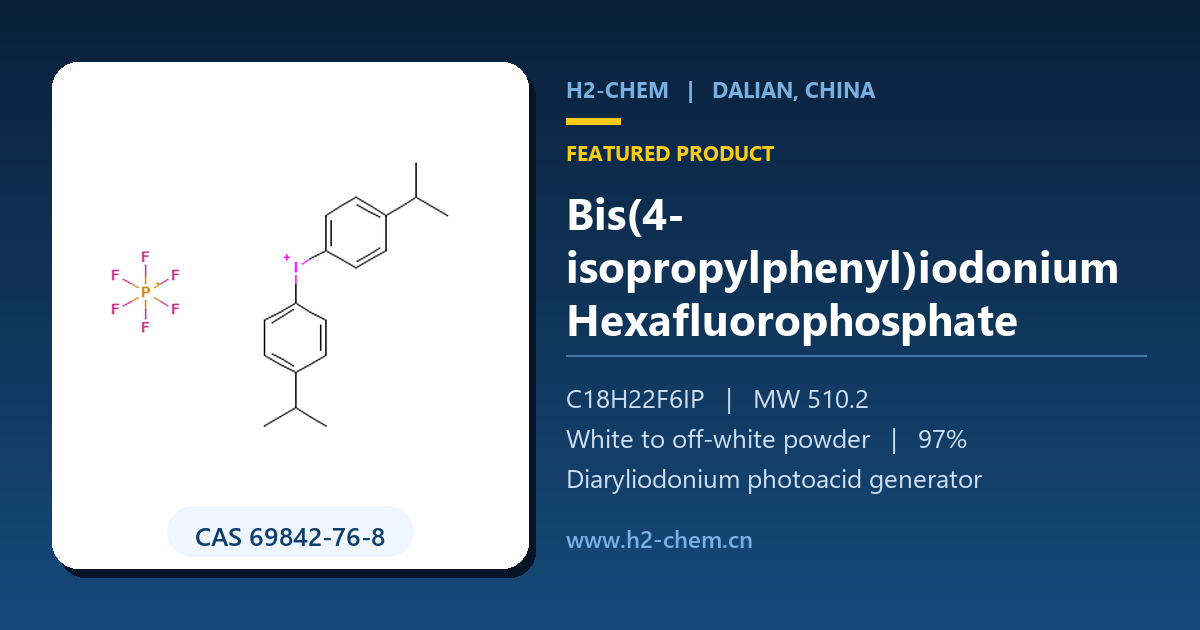
Most iodonium photoacid generators are sold as the diphenyliodonium cation, and most formulators run into the same limitation sooner or later: the salt will not stay dissolved in the reactive diluent long enough to be useful in a thin film. Replacing each phenyl ring with a 4-isopropylphenyl group addresses that without altering the photochemistry. CAS 69842-76-8 is bis(4-isopropylphenyl)iodonium hexafluorophosphate: a hypervalent iodine(III) cation carrying two para-isopropyl rings, balanced by a single hexafluorophosphate anion.
KEY IDENTITY DATA
CAS number: 69842-76-8
IUPAC name: bis(4-propan-2-ylphenyl)iodanium hexafluorophosphate
Synonyms: bis(4-isopropylphenyl)iodonium hexafluorophosphate
Molecular formula: C18H22F6IP
Molecular weight: 510.2 g/mol
Purity: 97% (H2-CHEM catalog grade)
Appearance: white to off-white powder
Storage: cool, dry, protected from light
PubChem CID: 20186106 (InChIKey HXEPXLSJIREXPF-UHFFFAOYSA-N)
CHEMISTRY OF THE CATION
The iodine atom in a diaryliodonium salt sits in a bent iodine(III) environment with a formal positive charge, and that charge is what makes the salt both an oxidant and a latent acid source: a single electron reaching the right place collapses the Ar2I+ unit into an aryl iodide and an aryl radical, and the counterion then releases a proton into the formulation.
The two isopropyl groups sit para to the iodine and are weak sigma donors. They raise electron density on the aryl rings, so the iodonium centre is more electron-rich than in the unsubstituted diphenyliodonium parent.
The steric difference is the one formulators notice. Branched alkyl groups interfere with crystal packing, so the salt dissolves far more readily in epoxy resins, oxetanes, vinyl ethers and the ester or carbonate reactive diluents that real formulations use. A photoinitiator that stays in solution is worth more than one with a better quantum yield that ends up as a crust at the bottom of the pot.
WHY HEXAFLUOROPHOSPHATE
The anion does three jobs at once. It is weakly coordinating, so it does not compete for the cationic centre or block the incoming monomer. It is almost non-nucleophilic, so the oxonium ion that propagates the chain is not terminated by its own counterion. And when the salt photolyses, it supplies the proton that opens the first epoxide ring, in the form of hexafluorophosphoric acid, a very strong Brønsted acid that will protonate an epoxide without assistance.
The one thing PF6 salts dislike is water together with heat. Hexafluorophosphate can hydrolyse to fluoride and phosphate species under those conditions, so keep the container dry and closed and avoid holding the material at elevated temperature for long periods.
FROM LAMP TO CROSSLINK
Unsubstituted diaryliodonium salts absorb mainly in the deep UV, well short of the 365 nm and 395 nm lines that dominate LED curing. Formulations therefore add a sensitiser, usually a thioxanthone or an anthracene derivative, that absorbs the lamp output and transfers an electron to the iodonium cation. Sensitised systems let this salt run on ordinary LED sources while the unsensitised powder keeps its shelf stability.
Cationic cure also keeps going after the light goes off. That dark cure is what makes iodonium photoacid generators attractive for pigmented films, thick sections and shadowed geometry where photons never arrive.
WHERE IT IS USED
- UV-curable coatings, adhesives, laminates and encapsulants built on epoxy, oxetane or vinyl ether chemistry, where cure must proceed without the oxygen inhibition that limits radical acrylates.
- Photoresists, imaging layers and holographic or optical recording media, where a photoacid generator with low mobility in the film is preferred.
- Sensitised LED curing at 365 nm and 395 nm, either alone or paired with a radical initiator in a hybrid cure.
- Electrophilic arylation in synthesis, where the salt transfers a 4-isopropylphenyl group to a nucleophile.
HANDLING AND STORAGE
Iodonium salts decompose slowly in daylight, so weigh under subdued light, keep the material in a tightly closed light-proof container, and store it cool and dry. The product is a fine powder: avoid dust generation, use local exhaust ventilation, and wear gloves and eye protection. Keep it away from strong reducing agents, bases and finely divided metals, all of which consume the oxidant and shorten shelf life.
SUPPLY AND DOCUMENTATION
H2-CHEM supplies CAS 69842-76-8 at 97% purity from Dalian, with a lot-based Certificate of Analysis covering assay and identity, and export documentation prepared for the destination market. Send the application, the purity target and the quantity you need and we will quote against the project, including custom synthesis or scale-up when the catalogue grade is not what your process requires.
Product page: www.h2-chem.cn/product.php?id=2074
Enquiries: sales@h2-chem.cn
NOTE: Intended for research, development and industrial manufacturing use. Not for diagnostic, therapeutic or veterinary use.