
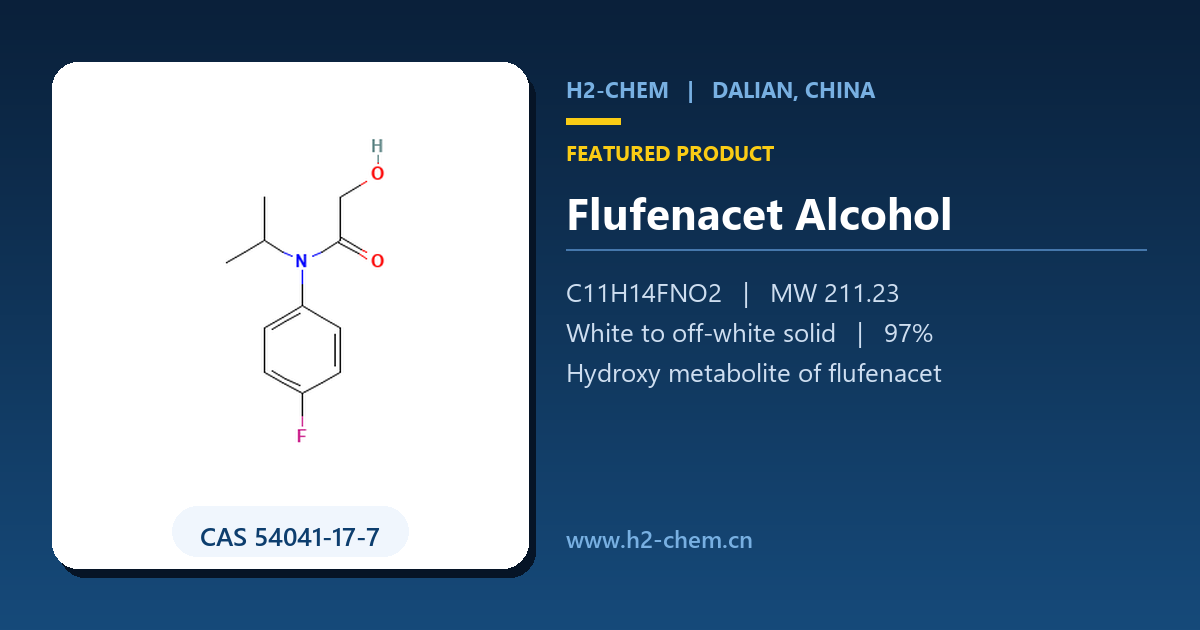
A herbicide metabolite earns its place on a laboratory shelf only when its identity is beyond argument. N-(4-Fluorophenyl)-2-hydroxy-N-isopropylacetamide, better known as flufenacet alcohol, is small enough to characterise completely: one aromatic ring, one fully substituted amide, one primary alcohol, and a single fluorine held para to the nitrogen.
KEY IDENTITY DATA
- CAS number: 54041-17-7
- IUPAC name: N-(4-fluorophenyl)-2-hydroxy-N-propan-2-ylacetamide
- Common names: flufenacet alcohol; flufenacet-hydroxy
- Molecular formula: C11H14FNO2
- Molecular weight: 211.23 g/mol
- Appearance: white to off-white solid
- Purity: 97%
- Estimated logP: about 1.6
- SMILES: CC(C)N(C1=CC=C(C=C1)F)C(=O)CO
- InChIKey: RISGISSUGUGJMO-UHFFFAOYSA-N
- PubChem CID: 6452934
THE GLYCOLAMIDE MOTIF
Two structural features decide how this compound behaves. The first is the amide nitrogen: it carries the 4-fluorophenyl ring and an isopropyl group, so the nitrogen has no hydrogen to donate. There is no N-H to form intermolecular hydrogen bonds, no acidic proton to deprotonate, and none of the self-association that makes primary amides poorly soluble. With no hydrogen-bond donor on the nitrogen, the molecule has little to hold itself together in the solid state.
The second is the alpha carbon. It bears a hydroxymethyl group next to the carbonyl, giving a 2-hydroxyacetamide, or glycolamide, unit. That alcohol is primary and unhindered, so it acylates, silylates and oxidises readily, while the adjacent carbonyl tempers its behaviour. Everything else in the molecule is largely inert under normal laboratory conditions: an aromatic ring, a para-fluorine, and the isopropyl group, which shields the amide from close approach.
Where the parent herbicide flufenacet carries a 5-(trifluoromethyl)-1,3,4-thiadiazol-2-yloxy substituent on that same carbon, the metabolite has lost the heterocycle and carries a hydroxyl instead. What remains is the polar, low-molecular-weight fragment left after the active substance is transformed in soil, plants or animals.
WHY THE METABOLITE MATTERS
Residue work on flufenacet rarely stops at the parent compound. The hydroxy metabolite is measured alongside it, and a method that reports only the parent can under-report the residue present. Every one of those methods needs an authenticated standard: a weighed solid from which the laboratory prepares its own stock solution rather than relying on a supplier's pre-mixed blend.
That is the practical role of CAS 54041-17-7.
TYPICAL LABORATORY USES
- Calibration and confirmation in LC-MS/MS residue methods for food, feed and environmental samples, where the protonated molecule appears at m/z 212 and the ion ratio must be checked against a known standard.
- Metabolism and degradation studies, in which the alcohol is quantified alongside flufenacet to establish a transformation pathway.
- Spiking and recovery experiments, including preparation of in-house quality-control samples when a matrix-matched standard is needed.
- Method development for related oxyacetamide herbicides, where glycolamide fragments recur in metabolite structures.
ANALYTICAL BEHAVIOUR
The amide/hydroxyl combination suits reversed-phase liquid chromatography with water/acetonitrile or water/methanol gradients, and the compound ionises in electrospray without derivatization. The 19F atom is a useful handle as well: it gives a single, sharp 19F NMR resonance and no isotope envelope of its own, which keeps the mass spectrum of the metabolite uncluttered.
For gas chromatography the primary alcohol is the derivatization site. Silylation with BSTFA or an equivalent reagent converts it into a volatile trimethylsilyl ether, and acylation gives the corresponding ester. The aromatic fluorine, by contrast, is not a reactive position under normal conditions; it sits on the aniline ring that carries through metabolism, and in the metabolite it survives as a spectroscopic label.
HANDLING AND STORAGE
The material is a solid at room temperature and is not reported as moisture sensitive. Store it in a closed container, cool, dry and protected from light, and keep it away from strong oxidising agents, which will attack the hydroxymethyl group. Weigh it in a ventilated area, avoid dust generation, and wear gloves and eye protection. Disposal and detailed PPE guidance should follow the batch-specific safety data sheet.
SUPPLY AND DOCUMENTATION
H2-CHEM supplies CAS 54041-17-7 at 97% purity from Dalian. Each lot is accompanied by a Certificate of Analysis covering assay and identity, with the CAS number, molecular formula and molecular weight stated on the certificate so the material can be matched against the analytical method. Export documentation is prepared for the destination country, and custom synthesis or larger quantities can be quoted against a supplied specification.
For a quotation, send the required quantity, the analytical method reference and the destination to sales@h2-chem.cn. The product page is at www.h2-chem.cn/product.php?id=9577
NOTE: Intended for research, development and industrial manufacturing use. Not for diagnostic, therapeutic or veterinary use.