
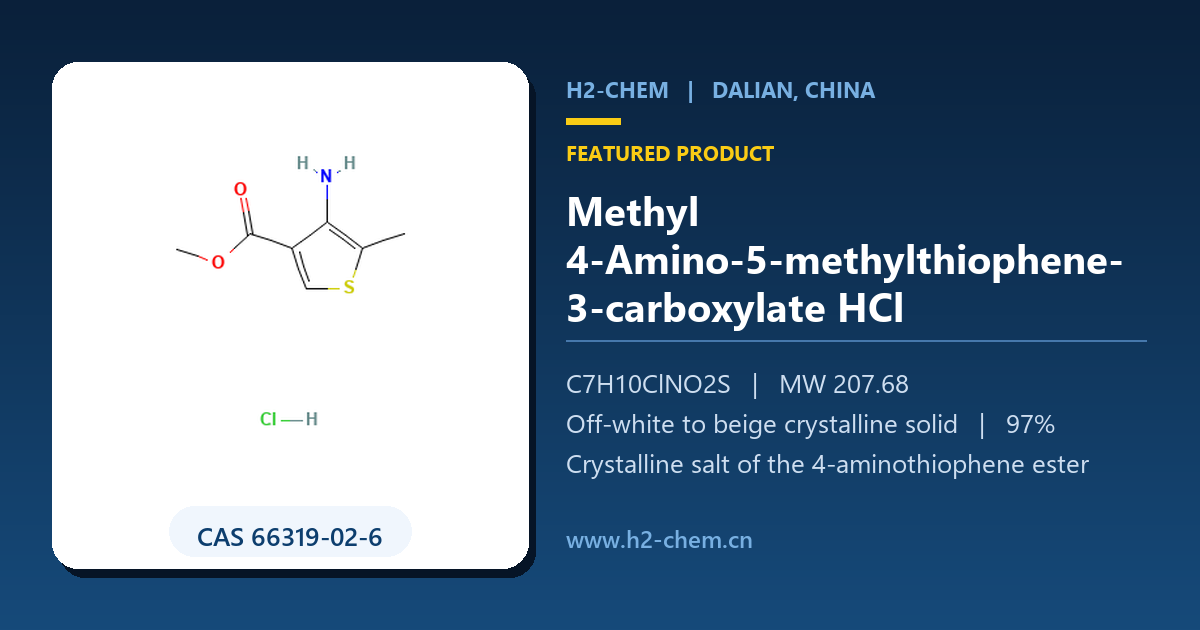
Methyl 4-amino-5-methylthiophene-3-carboxylate is offered as the free base (CAS 81528-48-5) and as its 1:1 hydrochloride (CAS 66319-02-6). The difference is a proton, not a synthesis, yet it decides how the material behaves on a balance, in a flask and in a bottle opened for months.
KEY IDENTITY DATA
- CAS number: 66319-02-6
- IUPAC name: methyl 4-amino-5-methylthiophene-3-carboxylate;hydrochloride
- Molecular formula: C7H10ClNO2S
- Molecular weight: 207.68 g/mol
- Appearance: off-white to beige crystalline solid
- Purity: 97%
- SMILES: CC1=C(C(=CS1)C(=O)OC)N.Cl
- InChIKey: QJXLLLDJKRNMEL-UHFFFAOYSA-N
- PubChem CID: 11506710
- Storage: 2-8 degrees C, dry, protected from light
WHAT PROTONATION ACTUALLY CHANGES
The thiophene ring, the ester and the C5 methyl survive salt formation untouched; the change is at the C4 nitrogen, whose lone pair now sits in an N-H bond with chloride alongside. In water the solid dissociates fully, and because the conjugate acid of an aromatic amine is weak (pKaH around 4) the free base returns as soon as the pH passes that window. Hence the salt dissolves readily in water, methanol and ethanol while staying out of the air oxidation that slowly darkens the free base.
SALT BREAK: THE STEP THAT IS NOT ON THE SCHEME
Every reaction that uses the C4 amine as a nucleophile, including acylation, sulfonylation, carbamate formation, reductive amination and the formamide condensation that closes the thienopyrimidine ring, needs the neutral amine. With the hydrochloride that costs one equivalent of base, planned into the stoichiometry rather than discovered at workup.
The simplest route is a partition: suspend the salt in dichloromethane or ethyl acetate, wash with saturated sodium bicarbonate or sodium carbonate, dry and concentrate. Alternatively keep the salt in the flask and charge triethylamine or N,N-diisopropylethylamine alongside the electrophile. Avoid aqueous sodium hydroxide when the methyl ester must survive, since saponification competes. Either way the chloride leaves in the aqueous wash.
WHY THE 4-AMINO-3-ESTER PATTERN STILL GOVERNS
The salt changes the physical starting point, not the chemistry. Ester at C3 and amine at C4 sit on adjacent carbons, the 1,2-arrangement that lets a single-carbon reagent bridge them into a thieno[3,4-d]pyrimidin-4-one. Gewald-type 2-aminothiophene-3-carboxylates close onto the 2,3-bond instead and give thieno[2,3-d]pyrimidines; the two series are not interchangeable. The C5 methyl is a second handle: next to sulfur it is benzylic, and N-bromosuccinimide converts it to a bromomethyl group for displacement or oxidation. The free-base note at www.h2-chem.cn/news.php?id=16 covers the scaffold in more detail.
WHERE THE SALT EARNS ITS PLACE
The choice is made on the solid rather than the solution. The hydrochloride is a free-flowing crystalline solid that weighs and dispenses accurately in small portions and dissolves quickly in the aqueous alcoholic media used for screening. Because any mild base regenerates the free amine, the two forms are interchangeable downstream; the decision is about handling and lot consistency, not reactivity.
TYPICAL DOWNSTREAM USE
- Condensation with formamide or an amidine to thieno[3,4-d]pyrimidin-4-ones and their 4-chloro derivatives, scaffolds with a long record in kinase inhibitor work.
- 4-Acylamino and 4-sulfonamido thiophene-3-carboxylates, where the amide N-H and the ester carbonyl form a compact donor-acceptor pair.
- Bromination at C5 followed by displacement or oxidation, for substituted thiophene libraries.
- Small sulfur heterocycles carrying three orthogonal functional groups for fragment and scaffold work.
HANDLING AND STORAGE
Hydrochloride salts of aromatic amines are hygroscopic: weigh quickly, reseal promptly and keep a desiccator for a bottle in frequent use. Store at 2-8 degrees C, dry and protected from light, and let containers reach room temperature before opening so condensation does not form on the solid. Use gloves, goggles and a dust mask in a ventilated area, avoid dust, and keep the material from strong oxidisers and strong bases, which liberate the free amine.
SUPPLY AND DOCUMENTATION
H2-CHEM supplies CAS 66319-02-6 at 97% purity against a lot-based Certificate of Analysis reporting assay and identity. The free base is a separate catalogue item and the two are often requested together against one specification. Export documentation is prepared for the destination market. Send quantity, grade and delivery point to sales@h2-chem.cn.
The current specification is at www.h2-chem.cn/product.php?id=9578
NOTE: Intended for research, development and industrial manufacturing use. Not for diagnostic, therapeutic or veterinary use.