
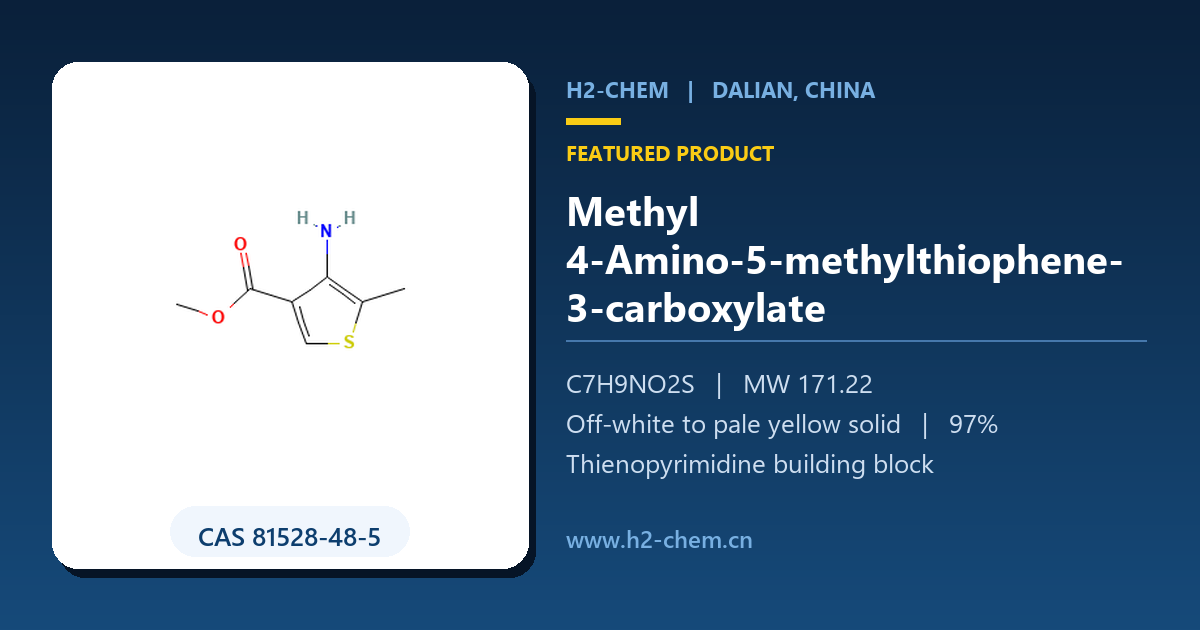
The Gewald reaction made 2-aminothiophene-3-carboxylates familiar to every medicinal chemist, and most catalog entries for "aminothiophene carboxylate" still describe that isomer. The compound here is the other one. Its ester sits at C3, its primary amine at C4 and a methyl at C5, which leaves a single unsubstituted ring carbon at C2. Moving the nitrogen from C2 to C4 is not a cosmetic change: it puts the amine and the ester on adjacent carbons, the exact 1,2-relationship needed to fuse a pyrimidine ring onto the thiophene, and it leaves the C2 position free for electrophilic chemistry.
KEY IDENTITY DATA
CAS number: 81528-48-5
IUPAC name: methyl 4-amino-5-methylthiophene-3-carboxylate
Molecular formula: C7H9NO2S
Molecular weight: 171.22 g/mol
Appearance: off-white to pale yellow solid
Purity: 97% (catalog grade)
MDL number: MFCD20526415
PubChem CID: 11401021
Storage: 2-8 degrees C, protected from light
THE 3,4-ARRANGEMENT AND WHAT IT ENABLES
Thiophene is a six-pi aromatic ring in which sulfur contributes two electrons, so the heterocycle behaves more like an electron-rich arene than like a diene. Substituents at C3 and C4 therefore talk to each other across a short, rigid distance. With an ester at C3 and an amino group at C4, both groups point toward the same edge of the ring, and a single-carbon reagent can bridge them. Formamide, formic acid or an amidine closes the ring to a thieno[3,4-d]pyrimidin-4-one, the fused series that corresponds to the 3,4-bond of thiophene. The 2-amino isomer behaves differently: it cyclizes onto the 2,3-bond and gives thieno[2,3-d]pyrimidines. Choosing between the two isomers is therefore a way of choosing which regioisomeric pyrimidine core a project receives.
The C5 methyl is a second, less obvious handle. It is attached to a carbon next to sulfur, so it behaves like a benzylic position: radical bromination with N-bromosuccinimide gives the bromomethyl compound, which can be displaced by amines, azide, thiols or alkoxides, or oxidized to the aldehyde. That sequence turns a readily available methyl group into a point of diversity without touching the ester or the amine.
DERIVATIZATION AT THE TWO POLAR GROUPS
The ester is the more forgiving of the two. Hydrolysis gives 4-amino-5-methylthiophene-3-carboxylic acid, a direct precursor to amides and to the acyl chloride; reduction with lithium aluminium hydride reaches the hydroxymethyl alcohol. Transesterification is straightforward in anhydrous alcohol.
The aromatic amine is the more reactive and the more sensitive. Acylation with acid chlorides or anhydrides, sulfonylation with sulfonyl chlorides and carbamate formation with Boc anhydride all proceed on the primary nitrogen. Reductive amination with aldehydes, and ureas or thioureas built from isocyanates, are also standard. Because the amine is attached to an electron-rich ring, it oxidizes readily; that is the main practical constraint on how long an open bottle can sit on the bench.
TYPICAL DOWNSTREAM USE
- Synthesis of thieno[3,4-d]pyrimidin-4-ones and their 4-chloro derivatives, scaffolds that appear in kinase and other heterocyclic screening libraries.
- Preparation of 4-acylamino and 4-sulfonamido thiophene-3-carboxylates, where the amide N-H and the ester carbonyl supply a hydrogen-bond donor/acceptor pair on a compact aromatic core.
- Fragment and scaffold work that needs a small sulfur heterocycle carrying three orthogonal functional groups.
- Intermediate for substituted thiophene-3-carboxamides after ester cleavage, a common motif in agrochemical and pharmaceutical discovery.
HANDLING AND STORAGE
Treat the solid as an irritant. Weigh it in a fume hood with gloves and eye protection, and avoid dust generation. The free amine darkens on prolonged exposure to air and light, so keep containers tightly closed, dry and protected from light, and store at 2-8 degrees C. Allow containers to reach room temperature before opening to prevent condensation. For long-term storage after opening, purge the headspace with argon or nitrogen. Keep the material away from strong oxidizers and from moist acids or bases that would hydrolyse the ester.
SUPPLY AND DOCUMENTATION
H2-CHEM offers CAS 81528-48-5 at 97% purity in laboratory and pilot-scale packs. Each lot is released against a Certificate of Analysis that reports assay and identity, and the material is packed to limit moisture and light exposure. Export documentation is prepared for the destination market. Send the quantity, specification and delivery point to sales@h2-chem.cn for a quotation.
For the current specification and packaging options, see www.h2-chem.cn/product.php?id=9579
NOTE: Intended for research, development and industrial manufacturing use. Not for diagnostic, therapeutic or veterinary use.
