
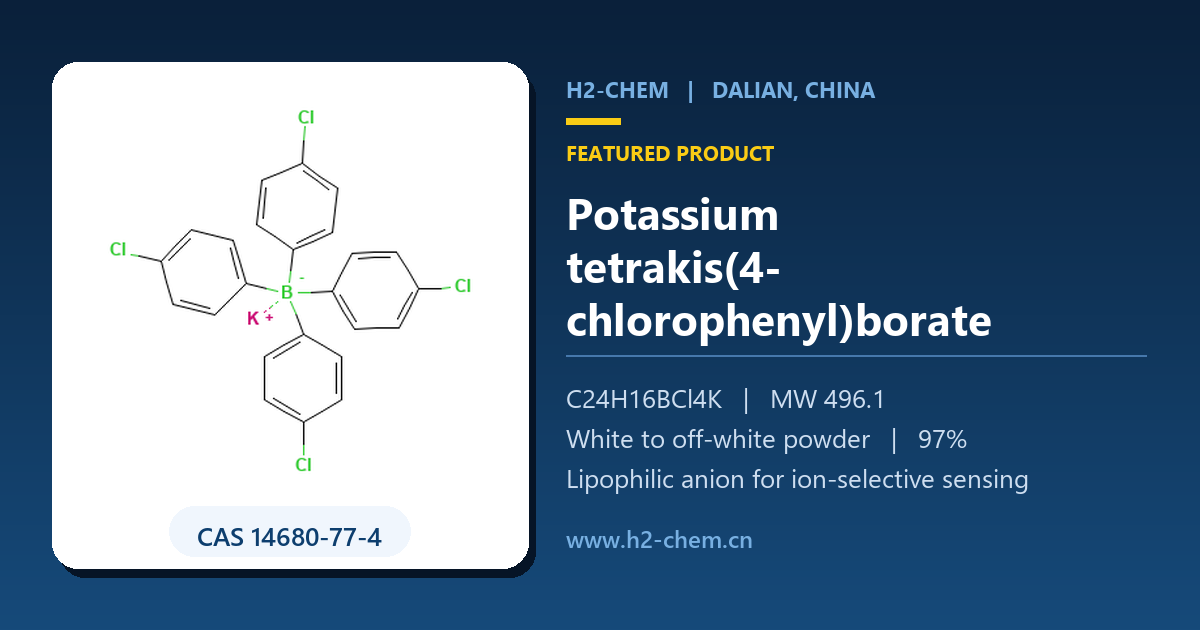
Potassium tetrakis(4-chlorophenyl)borate (CAS 14680-77-4) belongs to the tetraarylborate family, a class of salts defined less by what the anion does on its own than by what it prevents. The tetrakis(4-chlorophenyl)borate anion is large, weakly coordinating and carries a negative charge that is delocalized across four aromatic rings. That combination makes it highly lipophilic and poorly hydrated, which is exactly the profile required when a system needs a stable counter-charge inside a hydrophobic phase without the anion itself participating in the chemistry of interest.
KEY IDENTITY DATA
CAS number: 14680-77-4
Synonyms: potassium tetrakis(4-chlorophenyl)borate; K-TCPB; tetrakis(4-chlorophenyl)boron potassium
Molecular formula: C24H16BCl4K
Molecular weight: 496.1 g/mol
Appearance: white to off-white powder
Typical assay: 97% (H2-CHEM catalog grade)
Solubility: chloroform, dimethyl sulfoxide; poorly soluble in water
WHERE THE LIPOPHILIC ANION IS USED
Ion-selective membranes. In plasticized PVC membranes containing a cation-selective ionophore, the tetraarylborate salt acts as the anionic site. Without a lipophilic anion present, the membrane would be forced to admit hydrophilic counter-ions from the sample to preserve electroneutrality, which is precisely the interference that ion-selective electrodes are designed to avoid. Adding a bulky, hydrophobic anion such as tetrakis(4-chlorophenyl)borate keeps the membrane phase electroneutral without importing sample anions, and it lowers the membrane's electrical resistance.
Optodes and fluorescent sensors. The same mechanism supports optical sensing layers: a lipophilic anionic site, an ionophore and a pH or polarity-sensitive dye are co-immobilized in a thin film, and the anion holds the cation complex in the sensing phase. Published work using this salt includes sodium-selective fluorescent optodes.
Ion-pair extraction and precipitation. Tetraarylborate salts form stable ion pairs with lipophilic cations and can be used to extract or precipitate cationic species from aqueous solution, which is the basis of several classical gravimetric and colorimetric determinations.
Electrochemical supporting electrolyte. In non-aqueous electrochemistry, tetraarylborate salts are used as supporting electrolytes because the anion is difficult to oxidize and does not coordinate strongly to the species under study. The chlorophenyl variant sits between the less soluble phenyl analogue and the more heavily substituted fluorinated analogues in terms of lipophilicity and oxidative stability.
HANDLING AND STORAGE
The compound is supplied as a fine powder and should be handled with gloves and eye protection, since fine organic powders are readily dispersed. It is hygroscopic and should be protected from moisture and light. Short-term storage at 2-8 degrees C and long-term storage at -20 degrees C in a tightly closed container are typical, and the material is generally stable for at least two years under those conditions. Allow containers to reach room temperature before opening to avoid condensation.
Notes on solution handling: because the anion is designed to partition into hydrophobic phases, stock solutions are normally prepared in chloroform, dichloromethane or dimethyl sulfoxide rather than water. When preparing membrane cocktails, the salt is typically added at a small fraction of the ionophore concentration.
CHOOSING THE RIGHT COUNTER-ION
Tetraarylborate salts are not interchangeable from one application to another. The 4-chlorophenyl version is a common default where a balance of lipophilicity and cost is wanted. The 4-fluorophenyl analogue, sodium tetrakis(4-fluorophenyl)boranuide (CAS 25776-12-9), is frequently selected where a more electron-poor anion or a different solubility profile is needed, and it is stocked separately. Exchanging the counter-cation, for example from potassium to sodium or to a quaternary ammonium cation, changes the salt's solubility in the casting solvent without altering the anion's behaviour in the membrane.
SUPPLY AND DOCUMENTATION
H2-CHEM supplies CAS 14680-77-4 as a catalog item at 97% purity, with a lot-based Certificate of Analysis covering assay and identity. The compound is packed under conditions that limit moisture uptake, and can be supplied in laboratory quantities through to pilot scale. Export documentation is prepared per shipment for the destination market.
For stock, packaging and pricing, see www.h2-chem.cn/product.php?id=2076 or contact sales@h2-chem.cn with the required quantity and application. The related salt CAS 25776-12-9 is listed at www.h2-chem.cn/product.php?id=2075
NOTE: This product is intended for research, development and industrial manufacturing use. It is not for diagnostic, therapeutic or veterinary use.

