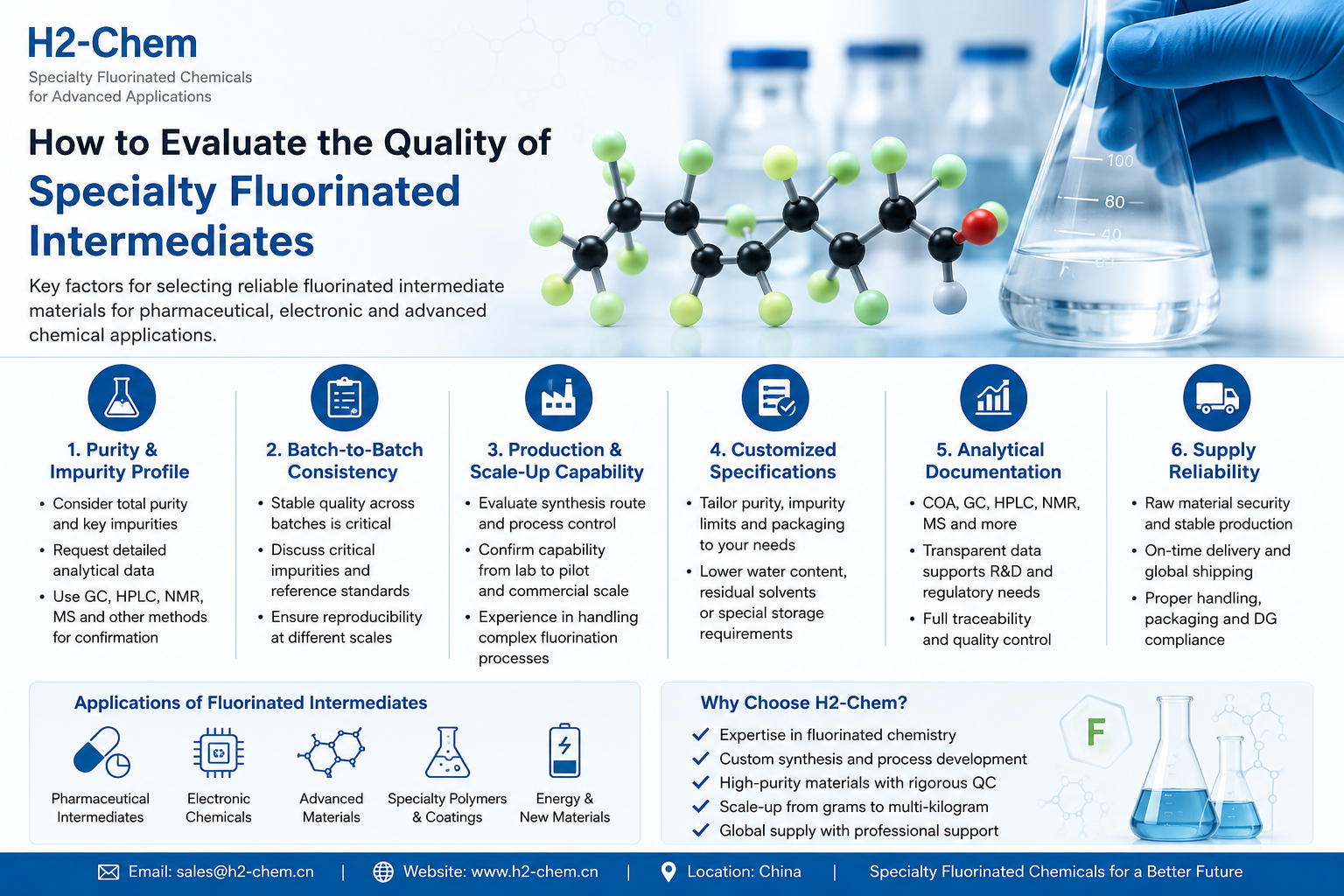
What Should Buyers Look for When Sourcing Specialty Fluorochemicals?
Fluorinated intermediates are widely used in pharmaceutical research, advanced materials, electronic chemicals, specialty polymers and other technology-driven applications. However, sourcing these compounds can be more challenging than purchasing standard commodity chemicals.
Many fluorinated compounds are produced in relatively small volumes and may require specialized synthesis, purification and analytical characterization. For this reason, buyers should evaluate a fluorochemical supplier based on technical capability and long-term supply reliability rather than price alone.
This article discusses the main factors to consider when selecting a supplier of **fluorinated intermediates and specialty fluorochemicals**.
1. Technical Experience in Fluorinated Chemistry
Fluorinated chemistry often involves different challenges from conventional organic synthesis. The choice of fluorination route, reaction conditions, materials of construction and purification methods can significantly affect product quality and production efficiency.
A reliable supplier should understand the characteristics of the target compound and be able to evaluate:
* Synthetic route feasibility
* Availability of key raw materials
* Reaction selectivity
* Potential impurities and by-products
* Purification requirements
* Scale-up risks
* Storage and transportation conditions
For specialty products, it is particularly important to work with a supplier that can provide technical support during both the R&D and commercial supply stages.
2. Ability to Support Custom Synthesis
Not every fluorinated intermediate is available as a standard catalog product.
Customers may require a compound with a specific CAS number, molecular structure, purity requirement or customized specification. In these cases, custom synthesis capability becomes an important factor.
A qualified custom synthesis supplier should be able to support projects from initial laboratory evaluation through larger-scale production.
Typical project stages may include:
1. Literature and route evaluation
2. Laboratory synthesis
3. Analytical characterization
4. Process optimization
5. Purification development
6. Pilot-scale production
7. Specification confirmation
8. Repeated commercial supply
For buyers, this capability can reduce the risk of changing suppliers when a project moves from gram-scale research to kilogram or larger-scale demand.
3. Purity Is Important, but Impurity Control Matters Too
A product specification showing “98% purity” does not always provide enough information for a specialty chemical application.
Depending on the downstream process, buyers may also need information about:
* Related substances
* Residual solvents
* Water content
* Molecular identity
* GC purity
* GC-MS data
* 1H NMR or 19F NMR characterization
* Molecular weight
* Batch-to-batch consistency
For fluorinated compounds, analytical interpretation can sometimes be more complex because fluorine atoms may influence NMR splitting patterns and other analytical characteristics.
Before placing a larger order, buyers should confirm which analytical data are available and whether the supplier can provide documentation appropriate for the intended application.
4. Evaluate Production and Scale-Up Capability
A supplier may be able to prepare several grams of a compound in a laboratory but have difficulty producing kilograms consistently.
For this reason, buyers should ask about the supplier's ability to scale the process.
Important questions include:
* Has the compound been produced previously?
* What quantities have been manufactured?
* Is the process suitable for repeated production?
* Are critical raw materials commercially available?
* What is the expected production lead time?
* Can future demand be supported?
For long-term projects, production consistency is often more important than the availability of a single batch.
5. Check the Supplier's Purification Capability
The synthesis of specialty fluorinated compounds may produce structurally related impurities that are difficult to separate.
A supplier's purification capability can therefore have a direct impact on achievable product quality.
Depending on the compound, purification may involve techniques such as distillation, extraction, crystallization, chromatography or other specialized separation processes.
Buyers should discuss the required specification early in the project. A technically realistic specification can help avoid delays caused by additional purification requirements after production has already started.
6. Consider International Shipping and Documentation
Many specialty fluorochemicals require careful handling during international transportation.
Before placing an order, customers should confirm:
* Product classification
* Available safety documentation
* Packaging options
* Export capability
* Shipping restrictions
* Required customs documentation
* Temperature or storage requirements
A supplier with experience in international chemical shipments can help reduce unnecessary delays during transportation and customs clearance.
7. Communication and Technical Responsiveness
For custom or specialty chemicals, communication is an important part of the supply process.
Customers may need to discuss a target structure, impurity issue, revised purity specification or production schedule. A supplier should therefore be able to provide clear technical feedback rather than simply confirming whether a product is “available”.
Effective communication can be particularly valuable when:
* A synthesis route needs to be evaluated
* The required quantity changes
* A purity specification is adjusted
* Additional analytical data are required
* Scale-up is being considered
A responsive technical team can help identify potential issues before they become production or delivery problems.
8. Look Beyond the Lowest Price
The lowest quotation is not always the lowest total procurement cost.
An apparently inexpensive product may result in additional costs if there are problems with quality consistency, impurities, delayed delivery or repeated supplier changes.
When comparing suppliers, buyers should consider the complete picture:
* Product quality
* Technical capability
* Analytical support
* Custom synthesis capability
* Scale-up potential
* Production lead time
* Documentation
* International logistics experience
* Long-term supply reliability
For specialty fluorinated intermediates, a stable technical and supply relationship can be more valuable than a small difference in initial price.
H2-Chem: Specialty Fluorochemicals and Custom Synthesis
H2-Chem supplies **specialty fluorochemicals, fluorinated intermediates, pharmaceutical intermediates and customized chemical products** for customers worldwide.
Our capabilities include chemical route evaluation, laboratory development, process optimization, purification and scale-up. We work with customers on projects ranging from research quantities to larger-scale supply requirements.
When submitting an inquiry for a fluorinated compound, customers are encouraged to provide:
* CAS Number or chemical structure
* Required quantity
* Target purity
* Intended application, if relevant
* Required analytical specification
* Target delivery time
Providing this information allows our technical team to evaluate the project more efficiently.
For inquiries regarding **fluorinated intermediates, specialty fluorochemicals or custom synthesis**, please contact H2-Chem with your project requirements.